Thoughts at the Network School
Montaigne's essays, Jung's psychology, and everyday conversations.

It has been over two weeks since I arrived here at the Network School. It is located at a Malaysian man-made island close to Singapore. The Network School (NS.com) is best described as a startup society and intentional community for techno-optimists, rather than a traditional school. It combines elements of a startup accelerator, digital nomad hub, co-living community, fitness retreat, and social experiment inspired by Balaji Srinivasan’s idea of the “network state.”
Coming to The Network School is one of the best decisions in my life. The culture here reminds me of the culture that we were able to build at the software company I founded 15 years ago. What impresses me most is the rare combination of intelligence and humility: many people that seem to genuinely seek to continuously learn and to question their own thinking. I realise how much I have been missing this in my life in the last few years. Every day here feels like nourishment for my psyche.
Two days ago, I met Dylan at the pool. We were both planning to go for a run, so we decided to do a 7.5 km loop around the island together. Dylan is originally from New York. He told me that he left his career in tech and accounting to come here and write, and that writing makes him feel truly alive.
After our run, we exchanged contact details, and he sent me a link to his Substack.
I just finished reading a few of his posts, and they inspired me to start writing and sharing some of my own thoughts.
Recently I have been studying the life and works of Michel de Montagne. Michel de Montaigne (1533–1592) was a French writer and philosopher who is often called the inventor of the essay. The word essay comes from the French word essai, which means “an attempt” or “a trial.” For Montaigne, writing was not about presenting perfect answers. It was about exploring ideas and trying to understand himself and the world.
To understand why Montaigne was so important, it helps to look at how people wrote before him. During the Middle Ages, most books were religious texts, histories, or philosophical works. Writers usually tried to teach people what was true and relied heavily on authorities such as the Bible, the Church, or ancient thinkers like Aristotle. Personal thoughts and feelings were not considered very important subjects for writing.
Another reason for this was that books were rare. Before around 1450, books had to be copied by hand by scribes, making them expensive and difficult to obtain. Then Johannes Gutenberg invented the printing press with movable type. Suddenly, books could be produced much more quickly and cheaply. Ideas spread all over Europe, helping to create the Renaissance—a period of renewed interest in learning, science, art, and the writings of ancient Greece and Rome.
The Renaissance encouraged people to think more about human nature and individual experience. But even then, most writers still wrote formal books that tried to explain or prove things. Montaigne did something completely new.
Instead of writing about great theories, he wrote about himself. He asked questions such as: Why are people afraid of death? Why do we change our minds? What makes a good friendship? Why do different cultures have different customs?
Montaigne openly admitted that he did not have all the answers. His famous motto was:
“Que sais-je?” — “What do I know?”
This attitude was revolutionary. Instead of pretending to be certain, he wrote honestly about his doubts, fears, mistakes, and changing opinions. His essays often feel like listening to someone think out loud. Writings before him would have more of a linear structure, with the aim to prove a point, like:
A --> B --> C --> Conclusion
His essays though, have natural detours and associations, much more aligned how we actually think, like:
A --> memory --> story --> question --> contradiction --> new idea --> partial conclusion
The essay became a journey of thought, not a finished argument.
Aside of structure his writing was very different from earlier writing in several ways:
He made his own experiences and thoughts an important subject.
He accepted uncertainty and doubt.
He wrote in a natural, conversational style.
He allowed himself to contradict earlier opinions and change his mind.
Some people loved this new style. Educated readers admired his honesty, intelligence, and deep understanding of human nature. His books quickly became popular among scholars and writers.
However, not everyone approved. Some critics thought he talked too much about himself. Others worried that his questioning attitude could weaken religious beliefs and traditional authority. His writing style also seemed too informal and unstructured to some readers.
Over time, however, Montaigne became increasingly respected. Writers and philosophers during the Enlightenment admired his open-mindedness and willingness to question accepted ideas. Later authors, including Emerson, Nietzsche, and Virginia Woolf, were strongly influenced by him.
Today, Montaigne is considered one of the first modern writers because he showed that ordinary human experience, personal reflection, and uncertainty are valuable subjects for literature. Modern essays, memoirs, opinion articles, and even many blogs all owe something to the writing style that Montaigne invented more than four hundred years ago.
So, the printing press made books widely available, the Renaissance encouraged people to think about human beings in new ways, and Montaigne took the final step by making the inner life of an individual person worthy of serious writing. That is why he is remembered as the inventor of the essay.
Learning about Michel and his style of writing immediately ‘clicked’ with me. I have never been much of a writer. I think I had this default inner belief that writing should be linear. I am extremely analytical: in my Computer Science degree I finished a course called “Advanced Logic” with a 10. A score that had never been achieved at that University for that subject before. Looking back, this same strength in logic might have been limiting me in writing: e.g. I would not allow myself to write down contradictions or a more thought-like structure with detours.
Understanding the life of Michel allows me to look more critically towards my default/existing inner beliefs about how writing should look like. When I think about it now, I belief the style of Michel is much more aligned with how we actual think and therefore in many situations a much more suitable and joyful approach.
So that is what I will be trying to do here next. I will actively try to free myself from my pre-existing beliefs on how writings should look like and actively allow for detours and more random associations.
That said, let’s get back to Dylan.
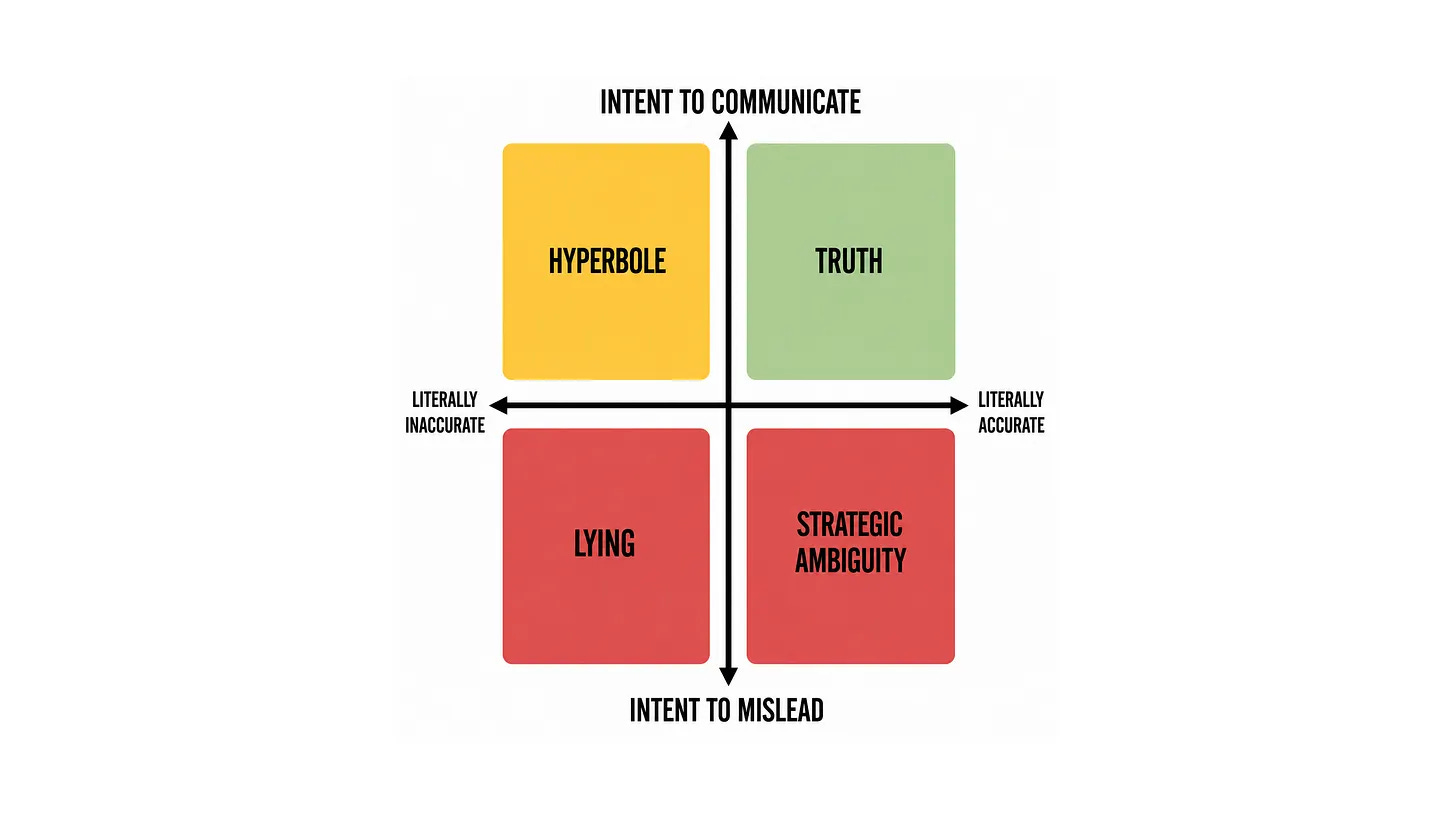
The first post I read, is called “The Four Quadrants or Communication” which he published a couple of days ago.

He starts out with this: “A statement can be literally false and not dishonest. A statement can also be technically true while creating a false impression. Therefore, intent determines honesty more than accuracy.”
He then draws this diagram:
4 Quadrants of Communication
This reminds me of something I’ve been reflecting on recently: how I respond to people and how I try to explain my own way of thinking.
Over the past few years, I’ve come to realise that my mind seems to be wired differently from most people. As a result, I often interpret situations and respond to them in ways that are quite different from what others expect.
One of the biggest pitfalls in communication is that we naturally interpret other people’s behaviour through the lens of our own minds.
The process often looks something like this:
Someone shows a particular response.
⬇️
We ask ourselves: “What would my own state of mind be if I responded like that?”
⬇️
We assume the other person must be in that same state.
I’ve learned that this way of reasoning is remarkably error-prone. It is often the source of misunderstandings, unnecessary conflict, and avoidable suffering. Different people can react very differently to exactly the same situation, so projecting our own inner world onto others can easily lead us astray.
A much better approach is simply to ask someone how they experienced the situation and how they arrived at their response.
Because of this, I’ve been making a conscious effort to explain more of my own internal reasoning to others.
I often illustrate it with a simple example.
Imagine I’m walking down the street and someone bumps into my shoulder.
There are several fundamentally different ways to judge what just happened.
1. Judging the action itself
Reasoning: People shouldn’t bump into me.
Someone bumped into me → Bad
The act itself is considered wrong, regardless of context.
2. Judging the outcome
Reasoning: Why should I be upset if no harm was done?
Did it hurt? → Yes → Bad
Did it hurt? → No → Okay
The judgement depends entirely on the consequences.
3. Judging the intention
Reasoning: What was the person’s intent?
Intended to cause harm → Bad
No intention to cause harm → Okay
The focus is on motivation rather than the outcome.
4. Judging recklessness or carelessness
Reasoning: Even without bad intentions, someone can still behave in a reckless or careless way that creates unnecessary danger.
Reckless or careless behaviour → Bad
No reckless or careless behaviour → Okay
Here, responsibility matters even when there was no malicious intent.
I’m curious which of these approaches you naturally tend to rely on.
Personally, I lean almost entirely on the last two. When I evaluate someone’s actions, I primarily look at their intent and whether they acted recklessly or carelessly.
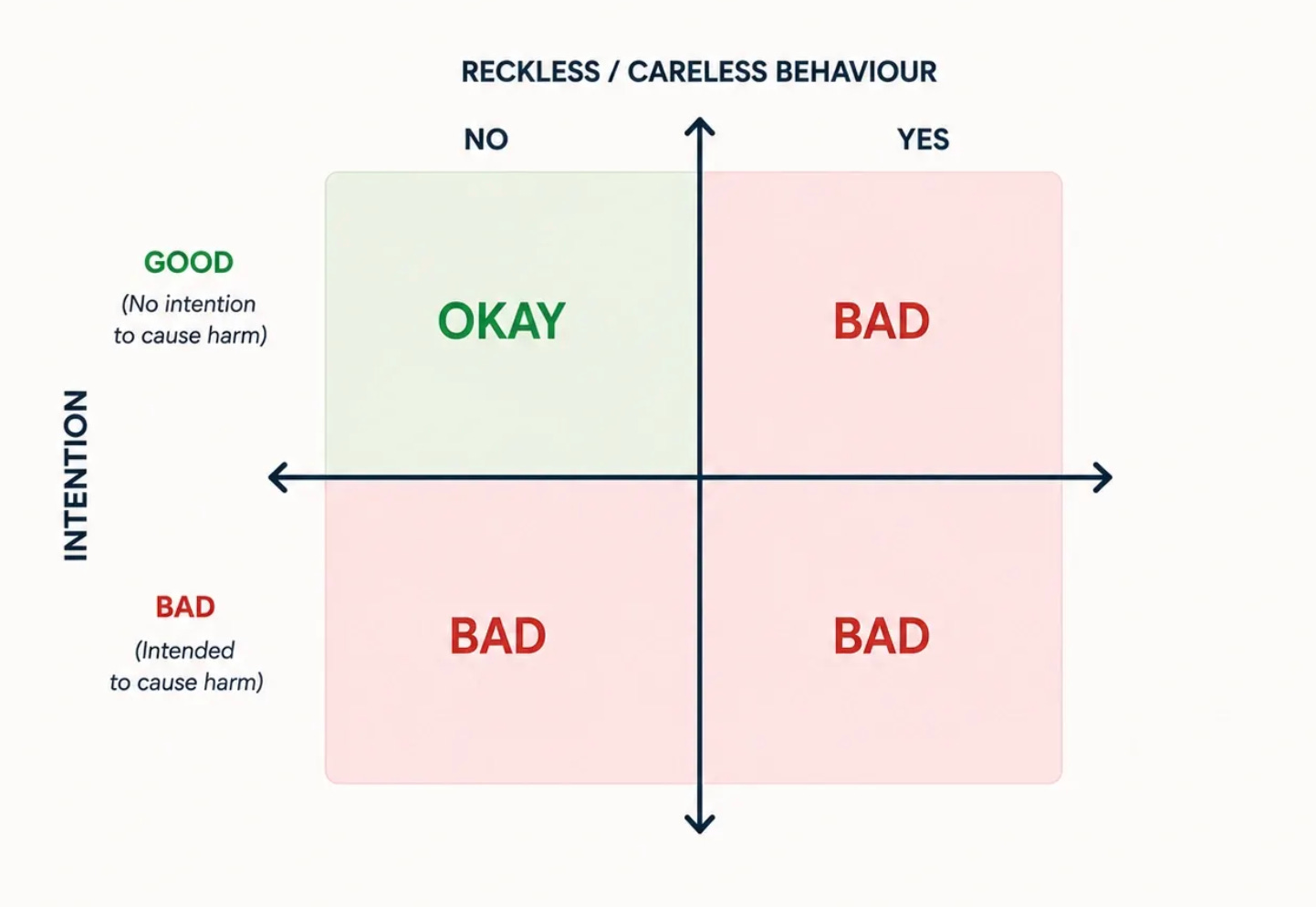
Earlier in life, I unconsciously assumed that other people judged situations in much the same way. Over time, I discovered that this often wasn’t true.
That led to some confusing interactions. People sometimes couldn’t understand why I was upset in situations where nobody had been hurt or where everything ultimately turned out fine. At the same time, they were equally puzzled when I wasn’t upset in situations where someone had been hurt or something had gone wrong—because, in my mind, there had been no bad intent and no recklessness.
Realising that people use fundamentally different frameworks to judge the very same event has helped me understand both myself and others much better.
This framework implies that both good intentions and careful behavior are required for something to be considered truly good. Any combination involving either bad intent or recklessness/carelessness falls into the bad category.
Let’s get back to Dylan’s model. It shows how he classifies individual statements in terms of judgement (okay, good or bad).
In the style of Michel de Montagne he gives us insight on how his inner reasoning works.
Let’s dive deeper.
Something that immediately stood out for me is Dylan’s relationship with truth. In another post he writes that he values truth and ‘hates’ lies, especially casual ones. He explains that a casual lie signals that you are willing to manipulate another person’s perception, even when the stakes are low.
I don’t know if I always agree. Let look into what exactly are casual lies: they are small, everyday untruths that people tell in ordinary social situations, usually without malicious intent. They are often told to avoid awkwardness, spare someone’s feelings, make conversations smoother, or avoid minor consequences.
Examples include:
“I’m almost there” when you haven’t left yet.
“I love your new haircut” even if you don’t really like it.
“Sorry, I was so busy” when you simply forgot to reply.
“That sounds interesting” when you’re not actually interested.
It made me think how I judge these type of lies. Like Dylan I value truths even if they’re uncomfortable or painful. But I believe I’m less hateful towards casual lies. Casual lies can overlap with concepts such as:
White lies – small lies intended to avoid hurting someone’s feelings.
Social lies – untruths used to maintain social harmony.
Excuse lies – minor lies used to avoid embarrassment or obligations.
Whether a casual lie is considered acceptable often depends on two factors:
Intent – Was the lie meant to help, protect, or manipulate?
Carelessness or recklessness – Did the person consider the consequences, or were they indifferent to the effects?
Most people view harmless white lies more leniently than lies intended to deceive for personal gain. However, frequent casual lying can gradually erode trust if it becomes a habit.
I feel that, when judging any situation or action—whether it involves telling the truth or telling a lie—I generally rely on the same Quadrant of Judgement. What I find interesting is that truth itself does not usually play a significant role in my evaluation. Instead, my judgement is primarily based on a person’s intent and the degree of recklessness or carelessness involved in their actions.
This makes me wonder whether truth itself should play a more central role in my judgement. The more I reflect on it, the more compelling this idea becomes. Looking back on recent events in my life, I believe that my judgement would have been better had I placed greater importance on what was actually true.
If truth is not an essential part of one’s judgement, people close to you gradually learn how you evaluate situations and may, consciously or unconsciously, adapt their behaviour accordingly. They might slowly move more and more away from truth while obscuring or actively manipulate your perception of their intent. When people are close together for over a longer periods of time, subtle forms of rivalry or competition can emerge, as René Girard describes in his Mimetic Theory, making this dynamic even more pronounced.
A very concrete example is when someone misrepresents what happened in the past and, when confronted with the truth, responds by saying, “That’s not how I remember it.” In this way, they can subtly reshape the narrative of past events in their favour while concealing any potentially self-serving or malicious intent behind their actions.
Over extended periods of closeness, subtle forms of rivalry and competition often arise. According to René Girard’s Mimetic Theory, people increasingly come to mirror each other’s desires, thereby deepening these dynamics and making departures from truth, as well as obscured or manipulated intentions, progressively harder to recognise.
But back to Dylan and hate for lies, especially casual ones.
Lately I have been studying the works of Carl Jung and I’m loving it. I have never been much interested in the human psyche before, but recent life events have led me on the journey to understand and discover more of this often so complex domain.
One statement or finding of Carl Jung is that: “Everything that irritates us about others can lead us to an understanding of ourselves.”.
That thought is a profound psychological principle. It suggests that our emotional triggers act as a mirror: the traits we find most frustrating in others often reveal our own hidden fears, insecurities, or unacknowledged habits.
It is remarkable how accurate this is. I’ve been seeing this in my own life/personality and in the people around me.
That’s why I was immediately triggered by Dylans statement that he hates lies. Could this emotion trigger act as a mirror? It is remarkable how accurate this statement seems to be because in another writing Dylan explains how he struggles with admitting he made a joke about being related to a famous hockey player, which is for me like a casual lie and nothing to be much worried about.
In general I am a strong believer that we want ourselves to see not as only good or bad.
That famous Carl Jung quote “I would rather be whole than be good” speaks to the courage it takes to integrate your shadow—the suppressed, messy, or socially “unacceptable” parts of yourself—rather than constantly performing as a flawless, palatable version of a “good” person.
Humans by nature are both good and bad. And the most dangerous people are the people that think themselves as only good.
History teaches us over and over again that the people who appear the most righteous are often the ones responsible for the greatest atrocities. Communism is perhaps the clearest example. On paper, it promises equality, fairness, and the end of exploitation—ideals that seem deeply moral and compassionate. Yet in practice, some of the largest-scale famines, purges, and political persecutions in history were committed by regimes acting in the name of those very ideals. This serves as a sobering reminder that noble intentions or virtuous appearances are never enough. Goodness must ultimately be judged by a commitment to truth, humility, and the real consequences of our actions, not merely by the ideals we profess.